More on Our Theoretical and Numerical Methods
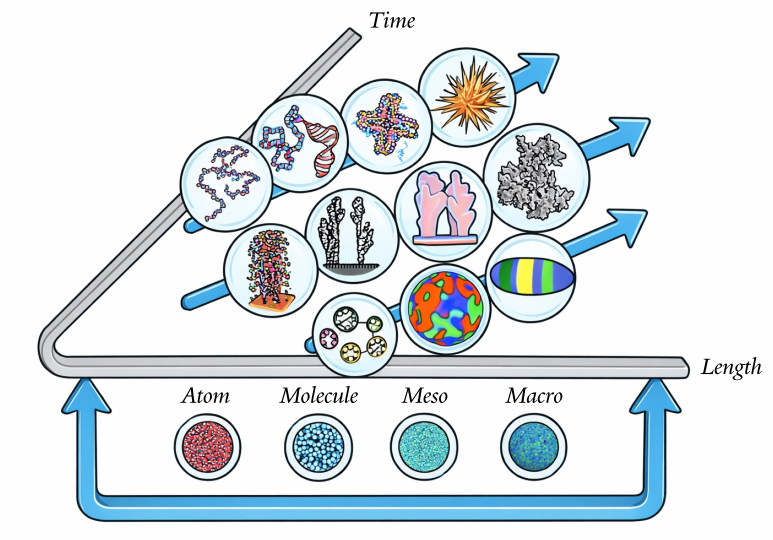
We are a theoretical research group focused on developing new multiscale theories and numerical methods to bridge disparate length and time scales in Chemistry and related fields. Our research draws on a broad range of computational tools and theory development, including but not limited to:
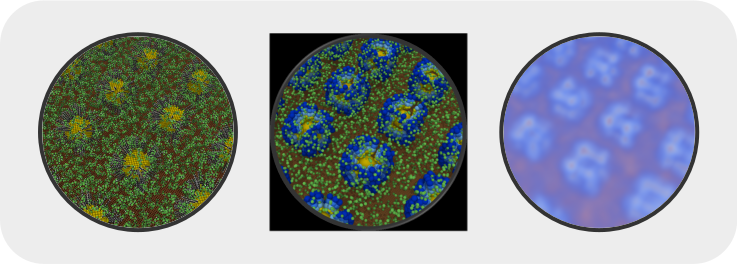
- Molecular and Particle-Based Simulations: Molecular dynamics, Monte Carlo methods (conventional, kinetic, auxiliary field), Brownian and Langevin dynamics, enhanced and rare event sampling, and Markov state models.
- Statistical Mechanics and Coarse-Graining: Equilibrium/non-equilibrium statistical mechanics, bottom-up coarse-graining, time-independent/dependent projection operators, generalized Langevin equations, linear response theory, and stochastic thermodynamics (fluctuation theorems, entropy production, thermodynamic uncertainty relations, and information thermodynamics).
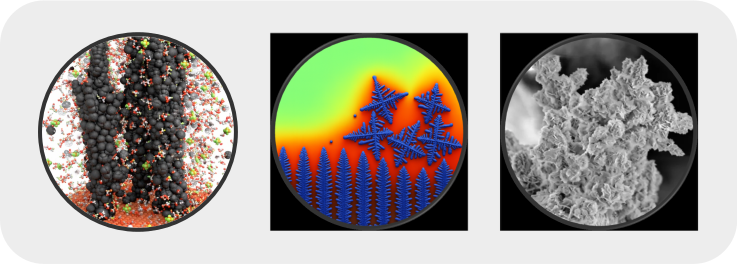
- Continuum Field Theories: Classical/dynamical density functional theory, fundamental measure theory, phase-field modeling, Models A–H, (fluctuating) hydrodynamics, reaction-diffusion models, polymer field theory, and Doi-Peliti field theory.
- Stochastic Processes and Non-Equilibrium Dynamics: Stochastic partial differential equations, Fokker–Planck and master equations, dynamical systems theory, Onsager-Machlup path integrals, large deviation theory, macroscopic fluctuation theory, and dynamical mean-field theory (Martin-Siggia-Rose formalism, cavity methods, and Kac-Rice theory).
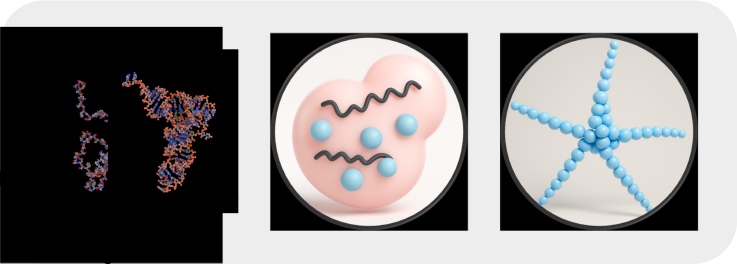
- Soft Matter, Complex Systems, and Data-Driven Modeling: Soft and active matter theory, polymer physics, nematic and glass physics, mode-coupling theory, liquid state theory, Bayesian inference, statistical learning, and machine learning.
By combining these theoretical and computational approaches, we investigate frontier problems spanning chemistry, chemical biology, biophysics, soft and active matter, non-equilibrium statistical physics, materials science, computational fluid mechanics, computational and developmental biology, synthetic biology, computational neuroscience, and artificial intelligence.
We welcome researchers interested in developing fundamental theories to address challenging interdisciplinary problems across these fields! Contact us here.